Entwicklungspolitische Begriffe
@ | A | B | C | D | E | F | G | H | I | J | K | L | M | N | O | P | Q | R | S | T | U | V | W | X | Y | Z | Alle
A |
|---|
B |
|---|
BehinderungZUR VERWENDUNG DER BEGRIFFE »BEEINTRÄCHTIGUNG« UND »BEHINDERUNG« Auf der Grundlage des heutigen menschenrechtlichen und sozialen Verständnisses von Behinderung ist ein Mensch mit einer wie auch immer gearteten individuellen Beeinträchtigung – sei es körperlicher, sensorischer, kognitiver oder psychosozialer Art – nicht per se behindert. Menschen mit Beeinträchtigung werden erst durch die in einer Gesellschaft vorhandenen Barrieren behindert, die eine volle soziale Teilhabe an allen Bereichen des Lebens erschweren oder gar verhindern. Da heutige Gesellschaften noch weit von einem idealen inklusiven Zustand entfernt sind, ist in dieser Handreichung sowohl von Menschen mit Beeinträchtigung als auch von Menschen mit Behinderung die Rede. Dadurch soll der nicht inklusiven Realität Rechnung getragen werden, mit der viele Menschen mit Beeinträchtigung und Behinderung weltweit zu kämpfen haben, bis sie eines Tages ihre vollen Menschenrechte und umfassende soziale Teilhabe genießen können. Quelle: VENRO | ||
C |
|---|
Capacity DevelopmentIm entwicklungspolitischen Kontext ist das Konzept des Kapazitätsaufbaus (Capacity Development) in den letzten Jahrzehnten in den Fokus gerückt. Im Kern geht es bei Capacity Development um den
Aufbau und die Weiterentwicklung fachlicher, methodischer
und politischer Kompetenzen von Partnerorganisationen
und ihren Zielgruppen. | ||
Church & Community Mobilisation ApproachChurch and Community Mobilisation Process (CCMP) | Umoja Church and community mobilisation involves mobilising a local church to act as a facilitator in mobilising the whole community to address their own needs. Once the local church is mobilised, it becomes a facilitator rather than the provider. The local church seeks to envision and empower community members to identify and respond to their own needs, rather than meeting those needs for them. The local church therefore works with rather than for the community. The community is in control. The local church can provide ongoing support to the community, and the community may call upon Christian organisations for technical support where necessary. (Quelle: Tearfund UK) | ||
Climate SecurityClimate security refers to the impacts of the climate crisis on peace and security, particularly in fragile and conflict-affected settings. Climate change can exacerbate food, water, and livelihood insecurity, with cascading effects such as increased competition over natural resources, social disruptions, and displacement. This can lead to increased tensions, conflict, and instability in a country or region. (Quelle: United Nations) | |
Community Engagement and AccountabilityCEA stands for Community Engagement and Accountability. It is the process of engaging communities and individuals at risk to encourage and enable them to uptake protective healthy behaviours and to address rumours and stigma and support community solutions during outbreaks such as the current COVID-19. | ||
CooperativeA cooperative is a business jointly owned and democratically controlled by its members to meet their shared needs. The members share collective responsibilities, and each of them has a say in how the business is run. Benefits derived from the cooperative are distributed equitably among the members. Quelle: Rabson Kondowe, D+C 2023/11-12, p.21 | ||
E |
|---|
EmpowermentEmpowerment steht für die Selbstermächtigung. Im Kontext der Entwicklungszusammenarbeit umfasst Empowerment Strategien und Maßnahmen, die Menschen dabei helfen, ein selbstbestimmtes und unabhängiges Leben zu führen. Dabei stehen benachteiligte Bevölkerungsgruppen im Fokus. Sie sollen etwa durch gemeinsames Handeln in die Lage versetzt werden, ihre Belange selbst zu vertreten und ihre Lebensbedingungen zu gestalten. Ursprünglich stammt der Begriff aus der Psychologie und der Sozialpädagogik. | |
F |
|---|
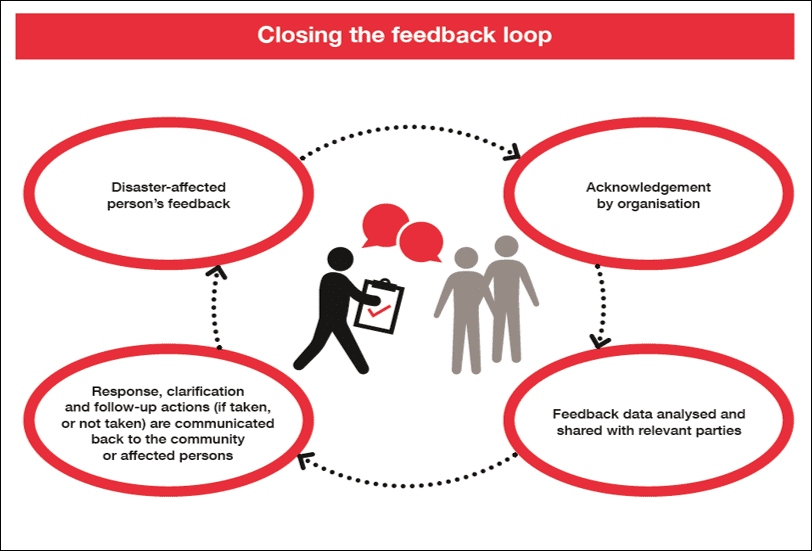
Feedback SystemA feedback and complaints system is a formal or informal system for receiving, analysing, responding to and acting on feedback and complaints from the community. The diagram below shows the feedback loop. Feedback and complaints systems need to receive, analyse, act on and respond to feedback. This process is seen as a continuous loop – if one stage is missing, then the feedback system is not fully functioning. If you are going to collect feedback it is absolutely critical that you respond and act on it otherwise you can damage your reputation with the community who feel they are providing feedback which is being ignored. It is helpful, therefore, to plan from the outset how you will collect feedback, analyse it and act on it – and who will be responsible for managing the system. This will need specific resources, including people and budget and support from senior management.
Quelle: IFRC | ||
Fragile StaatlichkeitDie Bedeutung von fragiler Staatlichkeit als Herausforderung für die internationale Zusammenarbeit nimmt zu.
Instabile und krisenanfällige Rahmenbedingungen sind
häufig dort zu finden, wo der Staat nicht in der Lage ist,
seinen Bürgerinnen und Bürgern innere und äußere Sicherheit zu gewährleisten oder soziale Basisdienstleistungen
zu erbringen. Wenn demokratische Institutionen zwar
vorhanden sind, aber nicht ihre Aufgaben erfüllen, spricht
man von »fragiler Staatlichkeit«. In Ländern mit fragilen
staatlichen Strukturen und schlechter Regierungsführung
herrscht vielfach Korruption, Vetternwirtschaft sowie ein
Mangel an Rechtsstaatlichkeit. Das Vertrauen in staatliche
Institutionen ist häufig gering. Meist geht staatliche Fragilität mit einem Höchstmaß an Armut und gesellschaftlicher Ungleichheit einher. Da Fragilität nicht immer ein
ganzes Staatsgebiet betrifft und auch länderübergreifend
sein kann, gibt es auch fragile Kontexte oder Räume fragiler Staatlichkeit. Auch Länder mit mittlerem Einkommen
können solche Räume fragiler Staatlichkeit aufweisen. In
einer Reihe von Schwellenländern gibt es beispielsweise ein
gestiegenes Konfliktpotenzial im Zusammenhang mit der
Ressourcenausbeutung.
| ||